


By Sofia Perez
[Published by Forbes, December 12, 2024]
For Marko Cilic, beekeeping is more than an activity—it’s a way of life that can be traced back to his family’s roots in Europe. “If you didn’t have bees, you didn’t have sweetness,” he says, speaking about his childhood in Croatia, where people traded honey and other homemade products with their neighbors. In 1995, at the end of Croatia’s civil war, Cilic’s family made its way to Canada, bringing that sweetness with them, and now it’s at the heart of his career. Along with his brother and a close friend, he is one of the co-founders of Burwood Distillery in Calgary, which sells a variety of spirits made with honey from their 4,500 beehives.
The 250 tons of honey that Burwood produces each year is a fraction of Alberta’s output, a province that is home to more than 1,950 beekeepers and 200 types of bees. In fact, Alberta is Canada’s leading honey producer, responsible for 40% of the country’s supply, and the third-largest producer in North America. That may surprise some, given that winter temperatures in the northern part of the province can plummet to minus 30 degrees Fahrenheit. But it also gets up to 18 hours of sunlight per day in the summer—nirvana for the bees, which also love the abundant clover and other forage found in its prairies, Canada’s top beef-producing region. And Alberta leads the way in rapeseed production (for canola oil), a crop that relies on bee pollination to boost output. In fact, Cilic rents out his bees, who work their magic for area farmers.
The province’s biggest metropolitan area is Calgary, designated a “Bee City” by the nonprofit Pollinator Partnership Canada, and it’s legal for individuals to keep up to two hives at home. But you don’t need to visit the city’s rooftops or gardens to see the impact these bees have had on Calgary’s food and drink scene.
Established in 2016, Burwood is one of Alberta’s first dedicated craft distilleries. The launch was made possible thanks to a change in the province’s regulations in 2014. The minimum volume that distillers are required to produce was drastically reduced. “[The previous amount] made it hard for individuals and entrepreneurs to get started,” says Cilic. “It killed the craft industry.” Thankfully, reports of its death were premature: There are now about 70 craft distillers in Alberta.
While Burwood produces gin and other spirits as well honey-flavored sodas and syrups, the distillery has made its mark thanks to its barrel-aged medica (a honey-based liqueur with Croatian roots); a delicious honey-spiced rhum; and Bee Whisperer, its smooth honey-based whisky, whose label features a drawing of Cilic in full beekeeper garb.
Burwood is housed in The Stables Building at the Currie Barracks, the former home of a cavalry regiment. Within the large structure, Cilic and his partners also run an educational center—which offers classes on distilling gin and absinthe, blending whisky, urban beekeeping, and the like—and a restaurant named Veranda, a joint venture with Vaycay Brew Co, which rents its brewery space from the distillery. Although Veranda’s menu changes quarterly, it always includes the Queen Bee, a pizza topped with tomatoes, mozzarella, basil, and a healthy drizzle of Burwood’s honey.
Honeybees Protect The Local Food Culture
Veranda is just one of the eateries serving up the fruits of bees’ labor. At Rouge, a farm-to-table restaurant near the Bow River, the menu features products straight from its backyard hives. For that, the owners can thank Karen Anderson, the founder and head of Alberta Food Tours and author of Eat Alberta First, a beautiful cookbook highlighting the province’s signature ingredients.
In her previous career, Anderson was a nurse practitioner who saw patient after patient suffering from diabetes, high blood pressure, heart disease, and obesity—conditions she attributes to a lost connection to local food. After she left nursing to start her family, she began writing about food and cooking, which segued into food tours of the city, an enterprise that eventually grew to cover the entire province. “I’ve always wanted to promote this food system and support farmers,” she says, “to create more of a food culture and value for food here in Alberta.”
Beekeeping is an important part of that food culture. As an official Bee City, Calgary has banned the spraying of pesticides and herbicides. “They’ve also reintroduced pollinator-friendly wildflowers and grasses on a lot of our boulevards,” says Anderson—who even took up beekeeping herself. Rouge was a regular stop on one of her food tours, and given the restaurant’s acre-sized garden out back, Anderson asked the owners if they would let her keep two hives there, to educate people on the contributions of honeybees. After a little convincing, they agreed and grew to love the bees, seeing their value, even beyond the honey they produced. The yield from Rouge’s fruit trees and vegetables increased by 50% after their arrival.
Anderson still raves about the cocktail she had at an all-honey dinner that Rouge hosted. “The bartender made this smoked-honeycomb old fashioned. Oh my God, it was delicious.” When she decided to get out of beekeeping after the pandemic, to focus on her growing tour business, the restaurant’s owners agreed to keep the hives, which are now managed by Anderson’s former beekeeping instructor.
Honey And Other Bee Products Sweeten Calgary’s Food Scene
Smack in the heart of Calgary’s downtown, bees are also buzzing around The Dorian, one of the city’s premier hotels, which debuted in 2022. Before the opening, executive chef Joshua Dyer was brought on to launch and manage all of the foodservice operations. Influenced by his time at the Fairmont Royal in Toronto, where there was a rooftop apiary, he saw bees as a priority. “That was my first exposure to the impact they have on our food supply. It’s important to make sure they’re healthy and productive.”
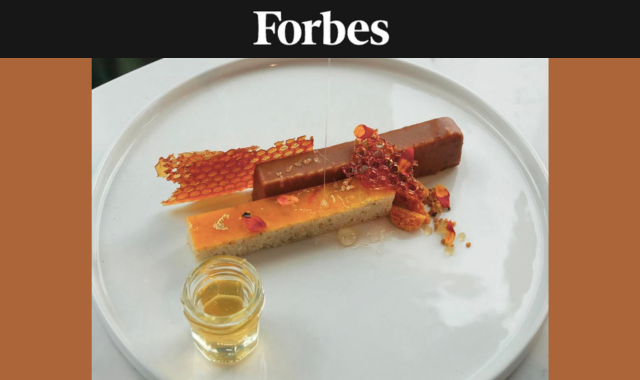
Productive, they are. The Dorian’s third-floor outdoor patio includes six beehives and a garden filled with herbs, tomatoes, peppers, and edible flowers. This year, Dyer and his team harvested about 100 pounds of honey per hive, which is sold in the gift shop and worked into the dishes—like the charcuterie board, sauces, dressings, and desserts—that are offered at all three restaurants and via room service. For example, at the property’s high-end Wilde on 27, the “Laburnum” dessert is inspired by a yellow-flowered plant that bees love (which is also mentioned in the writing of Oscar Wilde, the restaurant’s namesake). The dish consists of a brown-butter financier with a white-chocolate caramel crémeux and a honey tuile, finished with a drizzle of The Dorian’s lightly floral honey.
As Dyer tells it, however, the bees’ impact goes beyond what’s brought to the table. During the growing season, his staff visit the rooftop garden daily, to water the plants, tend to the hives and harvest flowers and herbs for the kitchen. “When you’re working in this industry, the food you order often comes in a box. You open the box, cook the food, and forget,” he says. “The garden and hives re-establish that connection to our ingredients.”
Keep Calm And Make Mead
No story on beekeeping and honey in Alberta would be complete without mentioning the province’s O.G., Fallentimber Meadery, about an hour north of Calgary. Launched in 2010, it is Canada’s highest-altitude meadery, at about 4,200 feet. Thanks to its location in the Alberta foothills and proximity to aspen forests, it produces a very distinctive honey. Co-founder Nathan Ryan explains: “Our bees are not in as much cropland as what you would generally see in the province, and you can taste the difference.”
Now the largest meadery in Canada, Fallentimber had humble origins. Ryan’s father was a farmer and beekeeper, selling most of his honey locally, with about a third going to the commodity market. Given the lack of economic opportunities in the area at the time, Ryan left home after high school, working at a ski hill and then in construction before enrolling in a tourism program at university. Although he had nearly completed his degree, he dropped out when his parents asked him to build them a house. The friend he was working with on that project happened to be into home brewing. “We found a chapter on mead in a home-brewing book, and since Dad always had 10,000 pounds of honey kicking around at any given time…” He smiles. “Turned out it was actually cheaper to steal honey from him than to buy grain to make beer.”
These days, there’s no stealing going on in this family-run operation. Now that Ryan’s parents are mostly retired, his brother Dustin handles beekeeping duties. while Ryan—who is allergic to bees—is the meadery’s production manager. (Ryan did eventually complete his degree, which included field study on creating an agrotourism company: Fallentimber.)
The bees make about 100,000 pounds of honey per year, enough to make Fallentimber’s entire product line. Although Ryan started with traditional meads, he also experimented with different styles, including session meads (a low-alcohol and carbonated version that makes up the bulk of Fallentimber’s mead inventory), braggots (a mead-beer hybrid) and sodas. But the stars of the lineup are the canned honey-based cocktails: Honey Colada, Honey Buck, and the easy-drinking Meadjito, the meadery’s bestseller—a honey-based spirit blended with fresh-squeezed lime juice, mint, and simple syrup that’s only 5% ABV.
In addition to tours and tastings, Fallentimber serves pizza on its patio every weekend during the warmer months, and it’s common for families to hang around all afternoon—eating, drinking, and walking the trails on the lush property. “We used to have cattle, but no longer do, and the grass leading into the forest is often neck deep,” says Ryan. “Behind the trees is a panorama of the mountains.”
That direct connection to nature is a theme that came up again and again during the interviews for this article. Honeybees are crucial for our food systems. “There are at least 10 to 15 herbs that would not exist if bees did not pollinate them,” says Burwood’s Cilic. While these small creatures flutter about from plant to plant, they also tether us to our environment. “The sound of the universe is ah-oom,” says Anderson, extending the final word into a long buzz. “When you’re working with bees, that sound is all you hear. The vibration of the universe.”