


By Sofia Perez
[Published by Forbes, December 16, 2024]
Located just east of Valencia, in the Mediterranean Sea, Spain’s beautiful Balearic Islands attract many visitors whose primary goals can be summed up as follows: beach by day and clubbing by night. I, on the other hand, went to the archipelago’s largest island to eat. (This will not surprise anyone who knows me.) What I found when I got there was a much more nuanced destination than its press would have you believe. If Ibiza is the hard-partying younger sibling, Mallorca is the first-born; she can still bust a move when she wants to, but she also knows how to enjoy life’s quieter pleasures, like great food.
While tourism is the island’s leading moneymaker, Mallorca does not feel like it is overrun by college students on spring break. Agriculture is an important industry, and if you drive through the island’s mountain ranges and past its valleys, you’ll see olive trees, almond groves, vineyards and citrus trees. From reading that list, you’d be right to assume that there is great Mediterranean food to be had. Here are three local creations that stirred my taste buds when I visited.
Mallorca’s Answer to Proust’s Madeleine
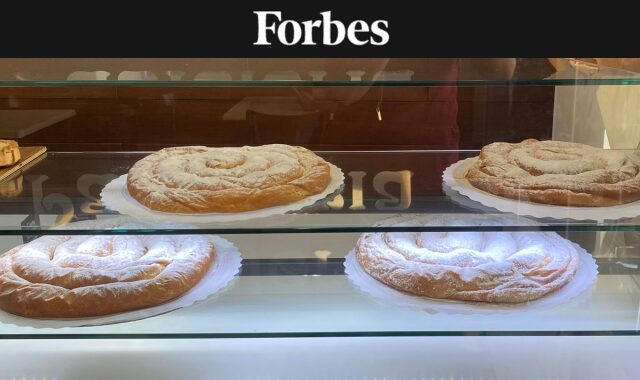
When I arrived at the airport in Palma, the island’s capital, I noticed quite a few departing travelers carrying flat octagonal boxes under their arms. As I soon found out, they contained large-format versions of Mallorca’s most famous dessert, the ensaïmada.
Like all great desserts, an ensaïmada is much more than the sum of its humble parts—flour, sugar, eggs and lard, along with yeast or a sourdough starter. Despite the lard content, a good ensaïmada is an airy delight. It may leave a ring on the outside of your mouth, in the form of icing sugar, but it’s not meant to be overpoweringly sweet, and folks often break off a piece and dip it into thick hot chocolate (as you would a churro).
Although I spotted ensaïmadas in various store windows around the city, I headed to a well-known bakery that’s down the coast in Colònia Sant Jordi, a popular beach town in southwest Mallorca. Established in 1967, Panadería Pons is a third-generation family-run business. It was fascinating to watch Cosme Pons and his son Sebastià roll out the ensaïmada dough until it was as thin as a veil, then form it into a long cylinder and coil it around itself; the end product resembles one of Princess Leia’s hair buns. Handling such a fine dough without tearing or overworking it is not easy, but you wouldn’t know that from watching their fingers fly over the workstation.
After proofing, the ensaimada goes into the wood-fired oven to bake before it is dusted with sugar and brought out to eager customers. While the Pons family also makes bread and other Mallorcan treats, the ensaïmada is the star of this bakery and comes in several classic varieties: filled with spaghetti squash, filled with sobrasada (a Mallorcan pork sausage—more on that below), and the plain version, which is anything but ordinary. I don’t have much of a sweet tooth, but I still smile when I remember that first bite, which is the point of any pastry worth its calories.
Spreading the Word About Mallorca’s Pork Sausage
When it comes to Spain’s cast of delectable pork products, chorizo and jamón ibérico hog all the attention, but the Balearic archipelago’s contribution deserves its own place in the pantheon. Sobrasada is quite simply cured pork heaven, a soft spreadable sausage that’s heavy on the pimentón (smoked paprika), which adds a little kick. The pliable texture is the result of the island’s humidity, but the softness is a feature not a bug, increasing the many ways that it can be enjoyed.
There are thinner and heftier versions, which use the same filling, and either size can be sliced into thick pieces, pan-fried and drizzled with honey, as they do at Vermutería San Jaime in Palma, but you can also enjoy it squeezed directly onto a good piece of bread. Of course, sobrasada is used in many recipes, too—enlivening small empanadas and the above-mentioned ensaïmadas, as well as topping another classic local dish, the coca, a flatbread that often gets compared to pizza (but don’t do that in the presence of locals).
Travel around Mallorca and you’ll encounter sobrasada in dishes both traditional and nouvelle, but if you’d rather cut to the chase, head to Colmado Sant Domingo, where the sausage is mentioned on the sign above the door. Founded in 1886, this tiny shop in the center of Palma is not for the claustrophobic, crammed as it is with cured meats, cheese and liqueur, but if it’s authentic housemade sobrasada you’re seeking, you’ve come to the right place.
The Mallorca Emblem That Represents Its Island Landscape
I first discovered Flor de Sal d’Es Trenc in a shop in Barcelona, back in 2004. While the plain version of this premium Mallorcan sea salt is outstanding, Es Trenc also produces a line that’s blended with dried herbs and seasonings, including thyme, oregano and rose petals. But the variety that blew me away was the black olive salt, made with roasted Kalamata olives. In fact, I loved it so much that I brought a tub of it home with me to NYC and used it on a range of dishes—in mixed green salads, on ripe summer tomatoes and around the rim of a cocktail glass. Much as I wanted it to last, however, the inevitable day came when I was faced with an empty container. Given that Es Trenc’s salts were not yet available in the States at the time, that was that. Cue the sad tuba.
Fast forward to June of this year, when Spain was the lead sponsor of the Fancy Food Show in NYC. As I walked the exhibitor floor, I passed stands promoting conservas and ibérico ham, until I spotted Es Trenc’s familiar pale-blue circular logo and made a beeline for the company’s representative. When I finally traveled to Mallorca a few months later, I visited the headquarters, to see the salinas (salt flats) firsthand and learn more about how the product is harvested.
Located near the southernmost tip of Mallorca, the company shares its name with the Es Trenc–Salobrar de Campos natural park, close to one of the island’s most prized beaches. Although people have been gathering salt in this area since the 5th century BC, commercial collection was abandoned for a long period, until operations finally resumed in 1950. The current owners took over in 2003, the year before my visit to Barcelona.
Es Trenc’s premium salt literally rises to the surface of the wetlands where it is collected, by hand, before being dried in the sun. Sustainability is at the heart of the company’s operations. Along with being organic, Es Trenc holds a slew of certifications for its maintenance of this unique landscape, which is a designated “special protection zone” for many bird species. It’s also home to Posidonia oceanica, an endemic sea plant that lines the island’s coast, forming verdant underwater meadows. The longest-lived organism on Earth, the plant is responsible for the health of these waters and is considered the lungs of the Mediterranean for the incredible amount of oxygen it produces, which protects many marine species.
All of these factors contribute to Es Trenc’s excellent flavor profile, which earned it first place in a ranking by Stiftung Warentest, a German consumer organization that compared it to famed salts like Guérande and Camargue. But what makes Flor de Sal d’Es Trenc so special is its connection to its beautiful home. In 2020, the archipelago’s government even added the product to its catalog of traditional foods of the Balearic Islands, making it an official emblem of Mallorca.